
FROM PLAY TO LEARNING: HOW TO DESIGN A GAME FOR MEDIA LITERACY
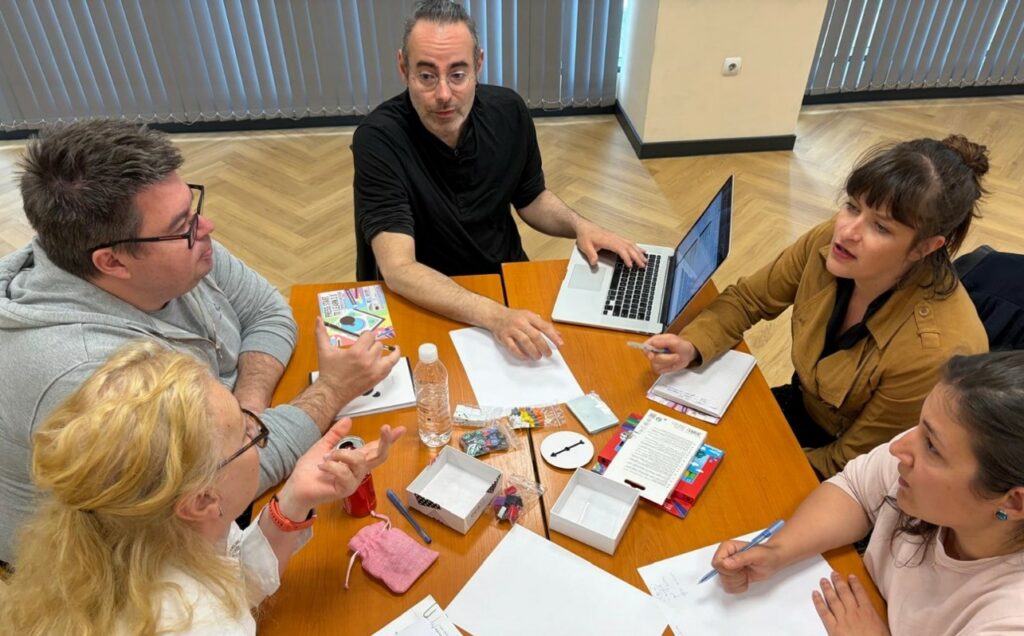
Media literacy games do not become effective by accident. Behind every board game, digital simulation, or classroom activity that successfully teaches players to question a source, spot a manipulated narrative, or recognize propaganda, there is a deliberate design process – one that sits at the intersection of two very different disciplines: game design and educational design.
This article looks at that intersection through the work of Luigi Russo, play educator and game trainer at Play Life Academy and Bangherang, who has developed a practical framework for building games with real learning outcomes. It offers a concrete answer to a question the Pixel Media project cares deeply about: not just why games can teach media literacy, but how to design one that actually does.
Two design processes, one goal
Educational design and game design follow parallel but distinct paths. Educational design typically moves through needs analysis, curriculum structuring, choice of methodology, delivery, and evaluation. Game design instead grows from an idea into a playable prototype through repeated cycles of testing and refinement – a single game can go through ten or more rounds of playtesting before its rules are considered stable.
At first glance, the two paths can look like they belong to different worlds. Russo’s framework recognizes instead that they are, in fact, superimposable: both share the same underlying structure – defining objectives, building a coherent system to reach them, and testing that system’s effectiveness. Where educational design speaks of needs analysis and evaluation, game design speaks of an initial spark of intuition and playtesting – but the underlying movement is the same: an objective is set, a system is structured (a curriculum on one side, mechanics on the other), and it is put to the test, iterating until it works.
It is precisely this structural overlap, often invisible at first sight, that makes it possible to bring the two processes together into a single design path. A game meant to teach is not simply an educational unit wrapped in a theme, nor a commercial game with a lesson bolted on. It requires both processes to run together, so that the mechanics of play and the objectives of learning reinforce each other from the very first sketch.
Why we play before we learn
Long before it became a pedagogical tool, play was – and remains – a protected space where cognitive, social, and ethical behaviors can be safely rehearsed. It functions, in effect, as a gym for the mind, supporting identification with a role, relationship-building with other players, modelling of real-world systems, and a kind of refuge from immediate consequences. This is precisely what makes play such fertile ground for developing critical media competencies: players can test how misinformation spreads, how propaganda is constructed, or how a biased source operates, without real-world risk.
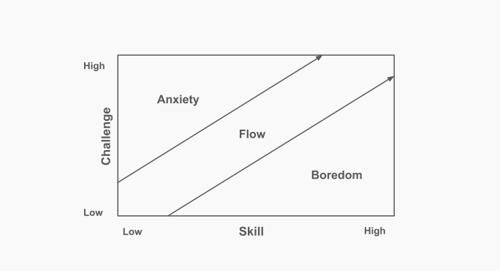
Play absorbs attention effectively becauce it causes us to enter the psycological state known as flow (Csikszentmihalyi, 2002): a condition of total concentration in which a person loses track of time, driven by immediate feedback and a careful balance between the challenge posed and the player’s skill. A game that is too easy produces boredom; one that is too hard produces anxiety. Media literacy games work best when they sit in that narrow band where the player is neither overwhelmed nor unchallenged – engaged enough to keep questioning what they see on screen or on the table.
The MDA model: designing from the inside out
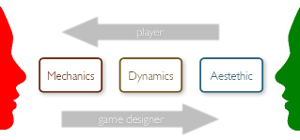
The most useful technical tool for connecting a game’s structure to its learning outcomes is the MDA model – Mechanics, Dynamics, Aesthetics – a framework widely used in game design theory (Hunicke et al., 2004).
- Mechanics are the rules and systems: the concrete actions a player can take.
- Dynamics are the behaviors that emerge when players actually use those mechanics – negotiation, bluffing, collaboration, competition.
- Aesthetics are the emotional and sensory experience the game produces: challenge, discovery, narrative tension, surprise.
For a media literacy game, this model becomes a design compass. Consider a mechanic built around fragmented, incomplete information: players receive only partial, unverified clues and are pushed to fill the gaps themselves. The dynamic that emerges is a natural inclination to speculate and to construct a plausible but unverifiable “complete” story – mirroring, almost exactly, how misinformation forms in real information ecosystems. The aesthetic experience is one of investigation that never resolves into a single absolute truth, leaving players with a felt understanding of epistemic uncertainty that a lecture on misinformation rarely achieves.
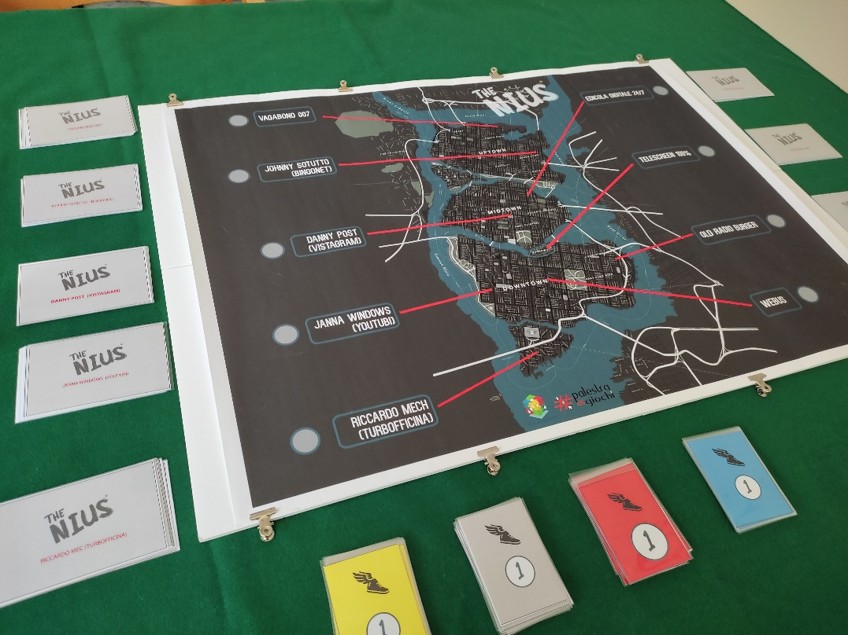
This is the approach behind The Nius, a board game created by Luigi Russo and Luigi Coccia that puts players directly inside the dynamics of misinformation stemming from fragmented information. Rather than explaining how fake news spreads, the game makes players complicit in producing it, which is precisely what makes the experience memorable.
Learning alignment: closing the loop
Designing engaging mechanics is not enough on its own. The step that turns a fun game into an effective educational tool is what Russo’s framework calls Learning Alignment: explicitly connecting each layer of the MDA model back to a learning outcome.
Before any of these connections can be drawn, though, there is a prior question that has to be answered – and it is here, not in the mechanics, that the real starting point of ludic-educational design lies: what do we actually want to teach? What is the understanding, or the meaning, we genuinely want to bring about in the player? Defining that objective with precision, before a single rule is written, is what separates a game designed for entertainment from one designed for learning. A game built for fun can start from a mechanic, a theme, or simply a feeling the designer wants to create. A game built to teach has to start from the objective – everything else, including the mechanics themselves, exists to serve it.
- Mechanic → Objective: in what way does a specific rule force players to engage with a concept? A scarcity-of-resources mechanic, for instance, can oblige players to grapple with sustainability trade-offs.
- Dynamic → Skill: in what way does the interaction train a competency? Negotiation over resources, for example, exercises emotional intelligence and perspective-taking.
- Aesthetic → Engagement: how does the emotional climate sustain the state of flow that keeps motivation – and therefore learning – alive?
This is the difference between “gamifying” a lesson and designing an experience in which the game is the learning. Objectives themselves are best defined across three levels: cognitive objectives (what participants must understand, such as how a fake news story is constructed), operational objectives (what they must be able to do, such as trace a claim back to its source), and transversal objectives (the soft skills at stake, such as critical judgment, collaboration, or resistance to manipulation).
From framework to practice: the debriefing moment
No matter how well a game is designed, the learning rarely completes itself during play – it is consolidated afterward, in a structured debriefing. A well-run session typically moves through a descriptive phase (what happened during the game), an analytical phase (what changed, and how did it feel), a didactic phase (what insight actually stuck), and an application phase (how does this transfer to real situations, such as evaluating a news feed or a social media post).
Skipping this step is one of the most common reasons games fail to deliver on their educational promise: without guided reflection, gameplay alone does not reliably translate into critical understanding. The facilitator’s role – whether acting as referee, in-game character, or observer – is what turns an entertaining hour of play into a durable competency.
A practical takeaway
For educators and designers working in media literacy, the value of this framework is that it is usable, not just theoretical. Mapping out a game idea against Mechanics, Dynamics, and Aesthetics, then explicitly writing down the Mechanic → Objective, Dynamic → Skill, and Aesthetic → Engagement links, is often enough to reveal whether a game concept will actually teach what it intends to teach – or whether it is simply entertaining.
Games like The Nius show what happens when this alignment is taken seriously: a genuinely playful experience that leaves participants with experienced understanding, rather than merely explained one, of how misinformation is built. That distinction between knowing about misinformation and having experienced its construction firsthand is where games earn their place as a serious tool for media literacy education.
References:
Csikszentmihalyi, M. (2002). Flow: The Psychology of Optimal Experience. Harper and Row.
Hunicke, R., Leblanc, M., & Zubek, R. (2004). MDA: A Formal Approach to Game Design and Game Research. AAAI Workshop – Technical Report, 1.