
Your Image in the Pixels: Why the Representation of Migrants in Video Games Matters More Than You Think
Have you ever played a video game and suddenly noticed how certain characters—especially those representing migrants or refugees—always seem to follow the same tired script? Maybe they’re the voiceless victim, the background NPC, or the “troubled outsider” who never really gets to tell their side of the story. If this sounds familiar, you’re not imagining things. Just like films, books, and TV shows, video games shape how we see the world—and yes, that includes how we see people on the move.
In fact, video games may be even more powerful than other media, because they invite us to participate. They don’t just tell us a story: they ask us to live it. But here’s the problem: in many of these stories, migrants either don’t exist at all, or when they do, they’re reduced to clichés. The refugee running from war. The undocumented worker. The shadowy figure crossing a border. These aren’t necessarily wrong stories, but when they’re the only ones told, something vital gets lost.
Two ways of telling the story
Too often, migrants are invisible in games. In blockbuster titles, you can journey through fantastical cities, dystopian futures, and alien planets without encountering a single character whose life has been shaped by migration. And when migrants do appear, they’re usually portrayed in ways that simplify their experience, often stripped of nuance, agency, or complexity.
- Invisibility
In mainstream blockbusters, migrants are nearly absent. When they do appear, they’re often background figures. Think for instance ofpeasants, flags bearers, or ghosts from the past. Their narrative impact is minimal. - Stereotyped representations
When present, they often fall into the trope of the “desperate refugee” or “struggling migrant,” reduced to one-dimensional figures of otherwise complex realities.
Why this matters
Because how people are represented in media affects how they’re treated in real life. It shapes our attitudes, our empathy, and our assumptions. If we only ever see migrants as desperate or helpless, we miss out on understanding the full, rich, often complicated reality of their lives.
- Normalization and bias
Video games implicitly transmit values. If migrants are always victims or threats, it reinforces dangerous narratives, just like we’ve seen in other media. - Loss of critical immersion
Emotional experiences in games like “Papers, Please” or “Bury Me, My Love” show how stories at the can educate and generate empathy. - Lack of authentic voices
When migrants are excluded from the creative process, narratives become fictional artifacts rather than genuine representations.
Some games that got it right
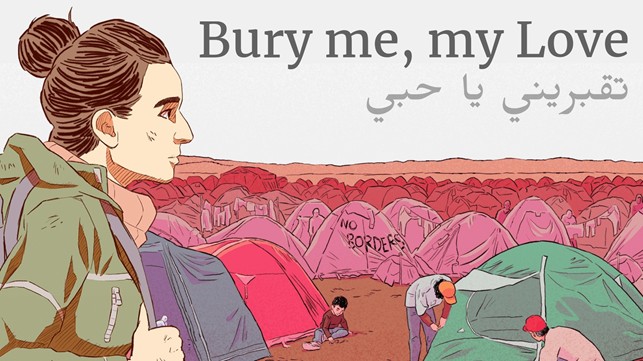
Thankfully, not all games fall into this trap. Some independent titles have taken bold steps to tell more honest, emotional, and thought-provoking stories (Council of Europe, 2023). “Papers, Please”, for instance, puts you in the shoes of a border control officer making decisions that affect real people’s lives. “Bury Me, My Love” tells the story of a Syrian woman fleeing her country, letting you experience her journey through messages sent to her husband. These games don’t offer easy answers. They make you feel the weight of every choice—and in doing so, they offer something incredibly rare in gaming: a chance to understand.
What Can We Do?
- Involve Migrants in the Creative Process
There are also games created with migrants, not just about Titles like “Typical Day” involve refugees in the design process, ensuring that the stories told are rooted in real experiences rather than assumptions (Martins et al., 2024). These games challenge players to see the world differently…and that’s exactly what good storytelling should do.
As Jack Gutmann (Council of Europe, 2023) puts it: “All video games are political… It’s important to involve refugees to ensure their perspectives are respected.”
- Embrace Complexity
Of course, the responsibility doesn’t fall only on game developers. As players, we can ask better questions. Whose stories are being told? Who gets to tell them? What voices are missing? The gaming industry, like the rest of the digital world, is slowly waking up to the importance of diversity and inclusion. But there’s still a long way to go.
Beatriz Pérez Zapata (Council of Europe, 2023) reminds us: “Simplifying is never a solution: showing the complexity is always the winning choice.”
- Support Inclusive Game Design
Creating games that represent migrants in authentic, respectful, and meaningful ways isn’t just a matter of social justice. It’s a matter of good storytelling. Because real stories—complex, messy, human stories—are always more powerful than stereotypes.
Studies by Darvishinia and Goodson (2024) show that well-designed games focusing on diversity increase both inclusion and learning effectiveness.
- Critically Educate Players
In a world where games are one of the most influential forms of culture, we can’t afford to ignore how they shape our perceptions. Representation matters. And when it comes to people who are often pushed to the margins,whether in real life and in virtual worlds, it matters even more. As the Council of Europe suggests, bringing such games into schools can support
In the digital world, the pixels you choose tell a story. Video games reflect reality—and often, they reflect what we think without realizing it. Portraying migrants in an authentic, empathetic, and respectful way isn’t just an aesthetic issue: it’s an ethical one (Penix-Tadsen, 2021).
It’s time to demand video game stories that represent our reality: not just about fantasy worlds, but about real people, full of hope, struggle, and resilience.
So next time you pick up a controller or start a new campaign, look closely at the world you’re stepping into. Ask yourself: who gets to exist here? Who gets to speak? And most importantly: who’s still missing?
Let’s make sure the answer isn’t always the same.
References:
Council of Europe. (2023, 8 june). EduTalks@Council of Europe: Migrancy, refugees and citizenship representations in video games. Council of Europe. https://www.coe.int/en/web/education/-/edutalks-council-of-europe-migrancy-refugees-and-citizenship-representations-in-video-games
Darvishinia, N., & Goodson, T. (2024). Diversity, Representation, and Accessibility Concerns in Game Development (Versione 1). arXiv. https://doi.org/10.48550/ARXIV.2407.04892
Martins, D., Fernandes, C., Campos, M. J., & Ferreira, M. C. (2024). Gamification Approaches to Immigrants’ Experiences and Issues: A Systematic Review. The International Journal of Information, Diversity, & Inclusion, 8(1), 83–102. https://www.jstor.org/stable/48775521
Penix-Tadsen, P. (2021, 9 october). What Far Cry 6 gets wrong about Cuba. Wired. https://www.wired.com/story/far-cry-6-cuban-representation/